
How Does a Vape Work? A Detailed Guide to Internal Components and Working Principles
This article explains in detail how a vape works, including its internal components and operating principles.
Vaping devices contain several interconnected components that work together to convert liquid into an aerosol. Although the external design can vary considerably between devices, many share a similar basic operating principle involving a power source, an electronic control system, an airflow mechanism and a heating element.
Understanding how these components work provides a clearer picture of the technology inside a vaping device. This guide introduces the main internal components, explains their individual functions and describes how the different systems work together during operation.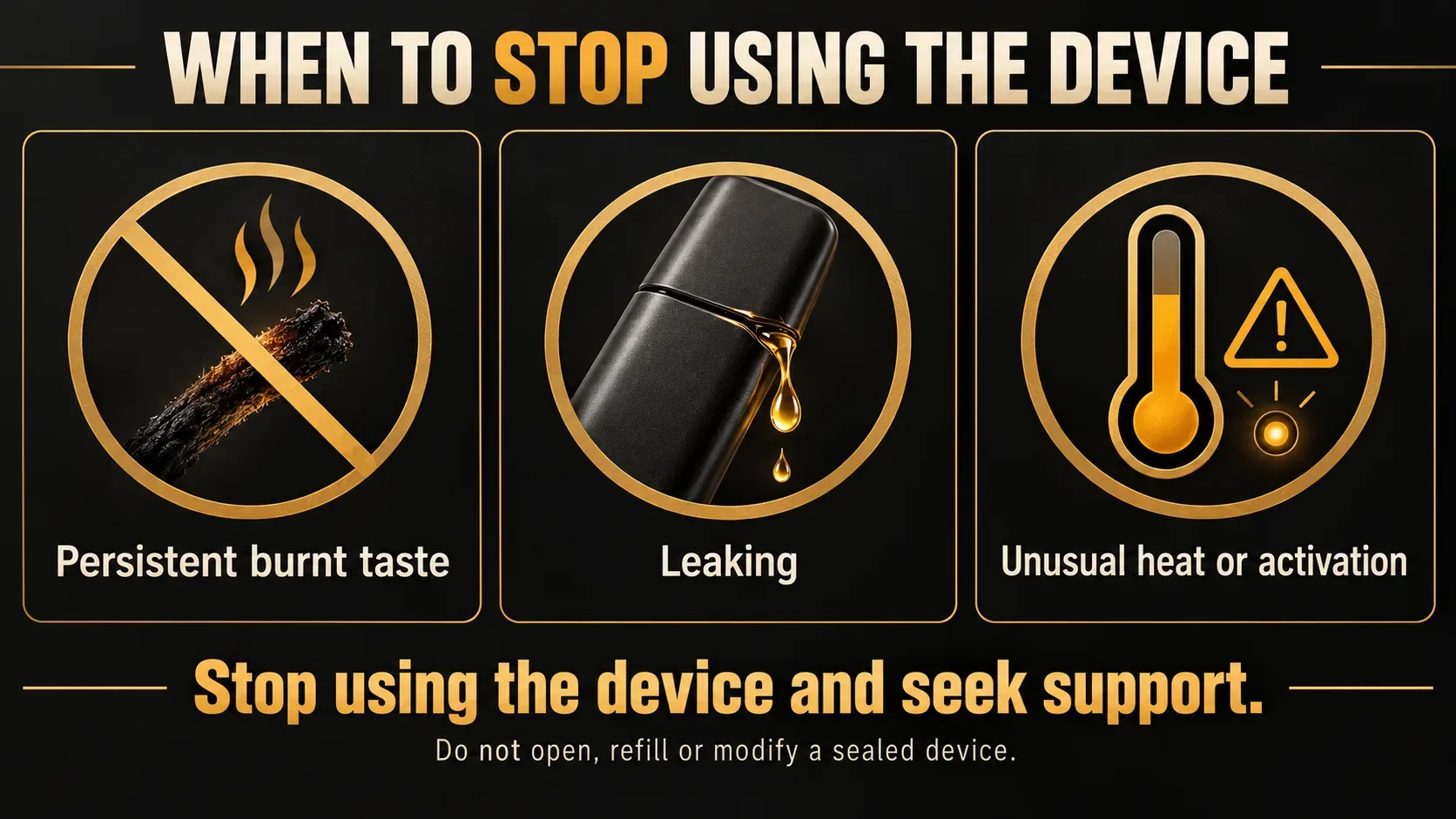
1. The Battery: Supplying Electrical Power
The battery is the primary power source in a battery-operated vaping device.
Many devices use lithium-ion or other lithium-based battery technology. The battery supplies electrical energy to the electronic circuitry and provides power to the heating element when the device is activated.
Battery specifications commonly include voltage, capacity and, where applicable, charging characteristics.
Battery capacity is usually measured in milliampere-hours (mAh). This figure indicates the battery's electrical charge capacity, but it does not independently determine the device's actual operating time or overall performance.
Actual performance depends on several factors, including electrical demand, heating power, battery condition, temperature and how the device is operated.
Some devices have rechargeable batteries, while others use sealed, non-rechargeable designs. The presence of a battery does not automatically mean that a device supports charging.
Battery condition and electrical protection are important considerations because damaged lithium-based batteries can present overheating and fire hazards.
2. The Electronic Control Circuit
The electronic control circuit manages the interaction between the power source and the other electrical components.
Depending on the device design, the control circuit may contain a control chip, switching components, electrical protection features and connections to the activation sensor.
Its functions may include:
Controlling the delivery of electrical power
Responding to activation signals
Managing display information
Monitoring selected operating conditions
Providing certain electrical protection functions
The exact functions depend on the circuit design and the components used in the device.
For example, a device with an integrated display may use its electronic circuitry to process information and show indicators such as battery status. A simpler device may not have a display and may provide only limited status information.
Even when a device includes electronic protection features, this does not guarantee that it will never malfunction.
3. The Airflow Sensor and Activation Mechanism
Many draw-activated devices contain an airflow sensor or a pressure-sensitive switching mechanism.
When a user draws on the mouthpiece and changes the airflow inside the device, the sensor may detect this change and send an activation signal to the control circuit.
The control circuit then manages the electrical supply to the heating element according to the device's design.
A typical activation process involves three stages:
The sensor detects a change in airflow.
The sensor sends a signal to the electronic control circuit.
The control circuit activates the heating system when the relevant operating conditions are met.
Not every device uses the same activation mechanism. Some designs use different types of sensors or switching arrangements, while others may include additional operating controls.
If a sensor becomes contaminated, obstructed or damaged, the device may fail to activate correctly. However, activation problems can also originate from the battery, electrical connections or other internal components.
4. The Heating Element: Converting Electrical Energy into Heat
The heating element is one of the core components of a vaping device.
When electrical current passes through the heating element, electrical energy is converted into heat. Under suitable operating conditions, this heat is transferred to the e-liquid near the heating surface, producing an aerosol.
Heating elements can differ in material, shape, resistance and surface area.
Two common design types are traditional wire coils and mesh heating elements.
Traditional Wire Coils
A traditional coil is made from resistance wire formed into a coil. Its heating characteristics depend on the wire material, resistance, geometry and electrical power supplied.
Mesh Heating Elements
A mesh heating element uses a metal structure with a mesh pattern rather than a conventional wound wire coil.
This structure can provide a different distribution of heating surface area. However, the overall performance still depends on the complete assembly, including the power supply, wicking material, airflow design and liquid properties.
Neither design automatically guarantees better performance or lower health risks. The entire device needs to be considered rather than judging it by the heating element alone.
5. The Wicking Material: Transporting Liquid to the Heating Area
Many vaping devices use a porous wicking material positioned near the heating element.
The wick helps transport liquid from the reservoir towards the heating surface through capillary action.
The type and structure of the wicking material influence how liquid moves through the assembly. Its properties may affect liquid supply, heating behaviour and the interaction between the liquid and the heating element.
If liquid delivery cannot keep up with the device's operating requirements, the heating element may not receive an adequate supply of liquid.
However, the exact design varies between products. Some devices combine the heating element and wicking material into a single replaceable assembly, while others integrate these components into a sealed structure.
The wick is therefore an important part of the overall heating system, but it does not independently determine the device's overall performance.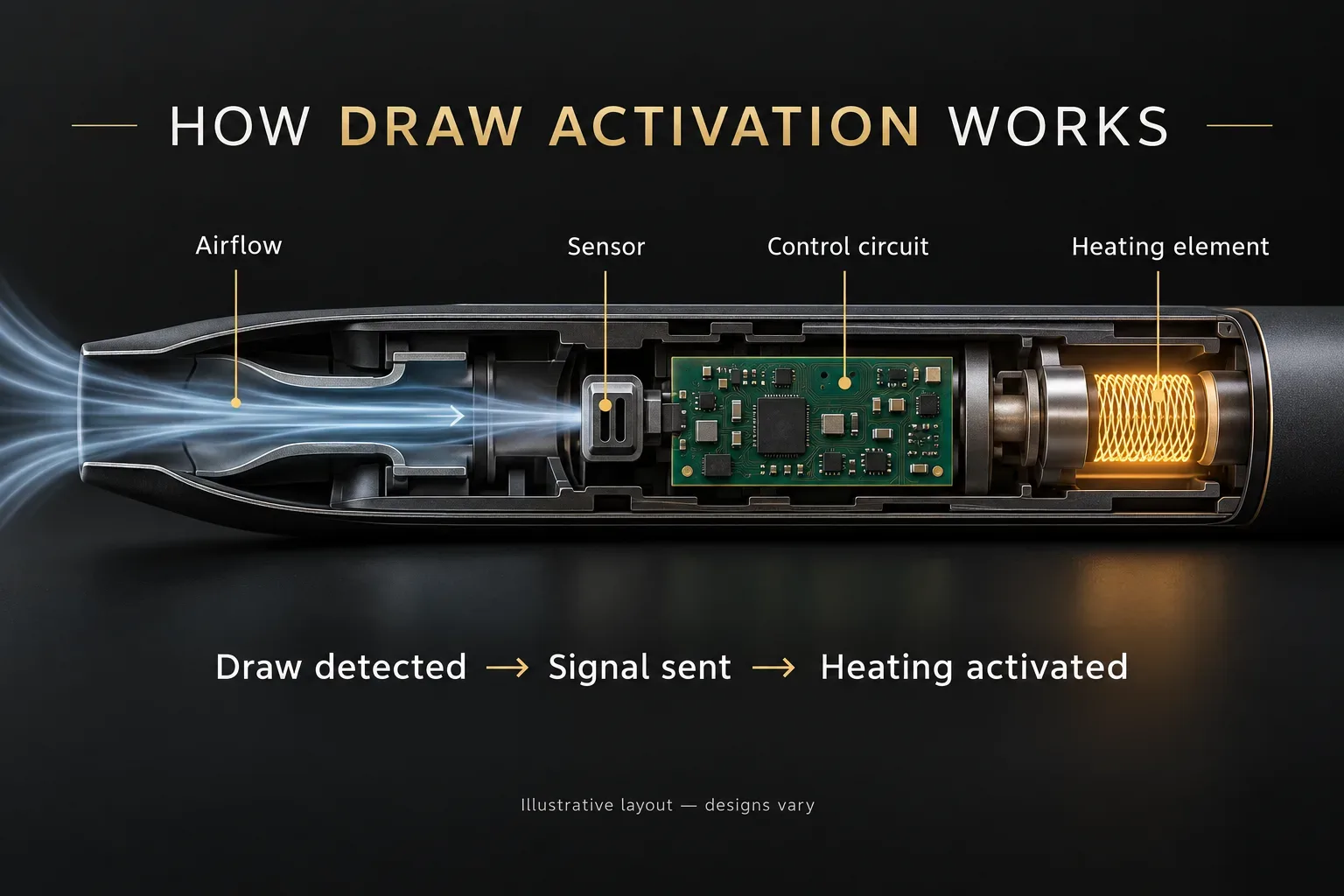
6. The E-Liquid Reservoir
The reservoir stores the liquid used by the device.
Depending on the design, the liquid storage system may be a refillable tank, a replaceable cartridge or a sealed, pre-filled container.
E-liquids may contain different combinations of ingredients, such as propylene glycol, vegetable glycerine, flavouring substances and, in some products, nicotine.
Formulations vary between products. The exact ingredients and their concentrations cannot be accurately determined from the external appearance of a device alone.
The reservoir must also work with the liquid delivery system. Its construction, seals and connections may affect leakage, liquid movement and how the heating assembly receives liquid.
Compared with refillable designs, sealed reservoir systems generally offer fewer components that users can maintain themselves.
7. The Airflow Pathway and Mouthpiece
Airflow is another important part of a vaping device's internal structure.
Air enters through designated openings, passes through the device's internal airflow pathway and moves through the aerosol-generating area before reaching the mouthpiece.
The airflow pathway may contain several internal channels. Their dimensions and arrangement influence pressure changes, draw resistance and the movement of aerosol through the device.
The mouthpiece provides the final outlet for the airflow and aerosol.
Airflow designs differ between models. The airflow system may also interact with the activation sensor, which means that inspecting the mouthpiece alone is usually insufficient to identify every airflow-related problem.
Blockages, condensation or liquid accumulation can affect airflow. However, the specific causes and appropriate handling procedures depend on the device model.
8. The LED Display and Monitoring System
Some vaping devices include an LED display or other electronic indicators.
Depending on the model, the display may show battery-related information, operating status or an estimate of the remaining e-liquid level.
These indicators are generated by the device's electronic system. The system may calculate or infer information from electrical measurements and other available signals.
A percentage shown on the display should not automatically be treated as a direct and precise measurement of the exact amount of liquid remaining.
For example, a battery indicator may estimate the charge level, while an e-liquid indicator may depend on the design of the monitoring system. Accuracy and available functions can vary between products.
A display can provide information about a device's status, but it cannot directly establish the composition of the e-liquid, the quality of the internal components or the overall quality and safety of the product.
9. How the Internal Components Work Together
The operating process of a typical draw-activated vaping device can be understood as a series of connected steps.
Step 1: Airflow Detection
The activation sensor detects a change in airflow.
Step 2: Electronic Control
The sensor sends a signal to the control circuit, which determines whether the heating system should be activated.
Step 3: Electrical Power Delivery
The battery supplies electrical energy to the heating element through the device's electrical system.
Step 4: Heat Transfer
The heating element converts electrical energy into heat and transfers that heat to the liquid near its surface.
Step 5: Aerosol Generation
Under suitable operating conditions, the heated liquid produces an aerosol that enters the airflow pathway.
Step 6: Airflow Through the Mouthpiece
The airflow carries the aerosol through the device and out through the mouthpiece.
This is a simplified explanation of the operating process. Actual devices may use different sensors, control systems, heating assemblies and liquid delivery arrangements.
10. Disposable and Reusable Devices: Key Structural Differences
Different vaping devices can vary considerably in how their components are assembled and maintained.
| Component or Feature | Sealed Disposable Design | Reusable Design |
|---|---|---|
| Battery | Usually integrated into the device | May be built in or removable, depending on the model |
| Liquid storage | Usually pre-filled and sealed | May use a refillable tank or replaceable cartridge |
| Heating assembly | Usually integrated or not designed for user replacement | May be replaceable, depending on the design |
| Maintenance | Few user-serviceable components | Selected components may be cleaned or replaced |
| End-of-life handling | The complete device requires appropriate disposal | Disposal requirements depend on the specific components being discarded or replaced |
These are general design characteristics rather than universal rules. Individual devices may differ, so the manufacturer's technical documentation should be consulted for model-specific information.
Devices containing batteries and electronic components also require appropriate end-of-life handling and should not automatically be treated as ordinary household waste.
11. Common Internal Problems and Their Possible Causes
If a device does not operate as expected, the problem may involve one or more internal systems.
The Device Does Not Activate
Possible causes include a depleted battery, a faulty airflow sensor, damaged electrical connections or a malfunctioning electronic control circuit.
Airflow Is Restricted
Possible causes include a blockage in the airflow pathway, liquid accumulation or damage to the mouthpiece or internal channels.
The Display Behaves Unexpectedly
Possible causes include an electrical connection issue, a display fault or a problem with the electronic control system.
Liquid Leakage Occurs
Possible causes include damaged seals, a failed reservoir seal, liquid accumulation or a fault in the internal assembly.
These symptoms do not identify a single cause with complete certainty. Unless a product is specifically designed to be safely serviced by a qualified person, it should not be dismantled to investigate internal faults.
If a battery-powered device becomes unusually hot, swollen, damaged or begins to leak, stop using it and follow the relevant manufacturer instructions and battery-safety guidance.
12. What Can and Cannot Be Learned from Internal Design?
Understanding internal components helps explain how a vaping device operates, but publicly available product specifications provide only part of the overall picture.
A higher stated battery capacity does not independently prove that a device will operate for longer. Using a mesh heating element does not prove that a product will perform better. An LED display may not provide precise measurements, and an integrated internal structure does not automatically demonstrate product quality.
Other factors also matter, including component quality, electrical design, e-liquid formulation, manufacturing consistency and applicable testing.
Product descriptions should therefore be distinguished from performance results that have been independently verified.
For Australian readers, product specifications and technical features also do not establish whether a particular device can legally be imported, supplied or advertised.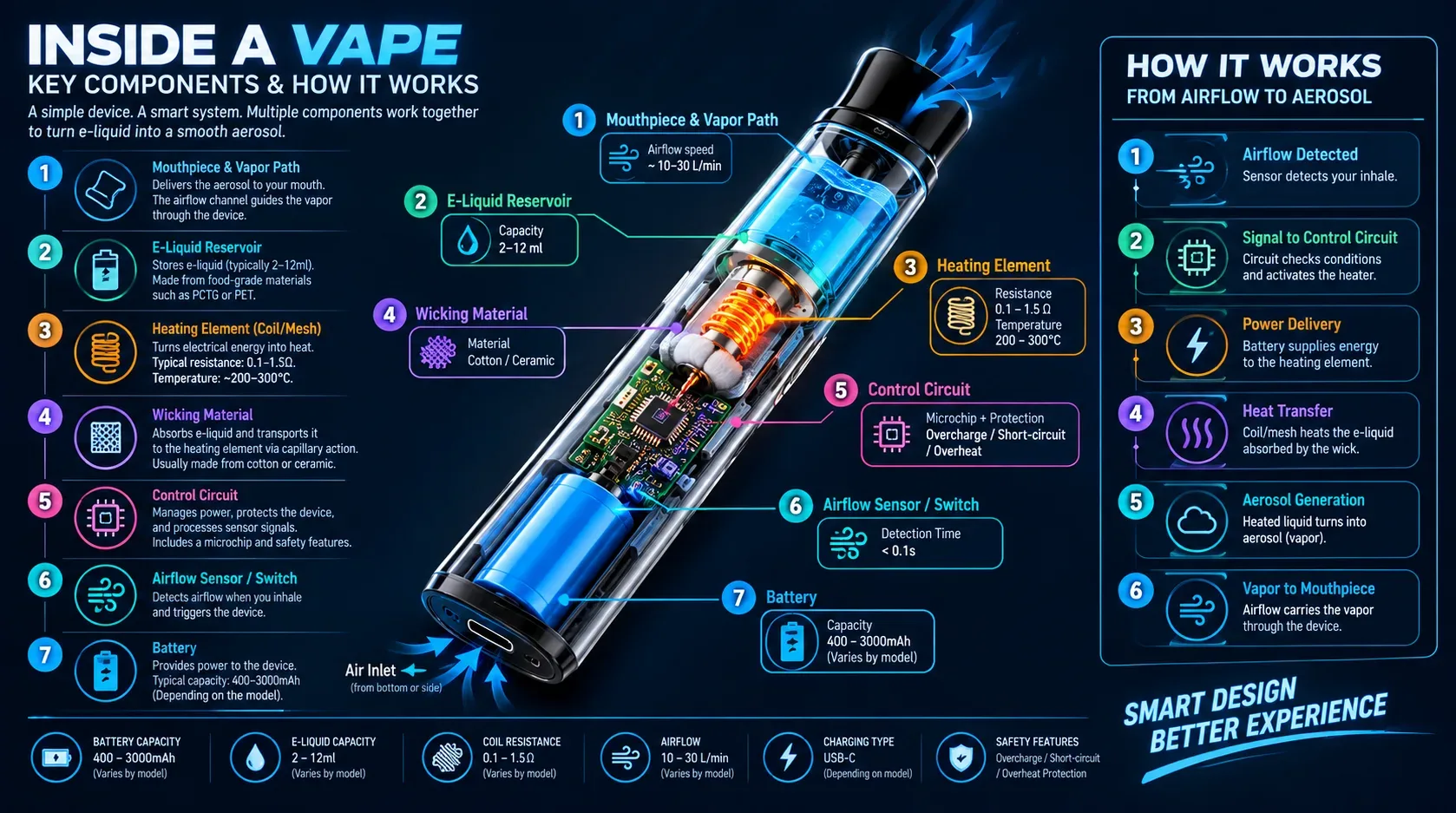
Frequently Asked Questions (FAQ)
Q1: What are the main internal components of a vaping device?
Common components include a battery, electronic control circuit, activation sensor, heating element, wicking material, e-liquid reservoir, airflow pathway and mouthpiece. Some models also include an LED display or additional electronic monitoring features.
Q2: How does a vaping device generate an aerosol?
In a typical battery-operated device, the activation mechanism sends a signal to the control circuit, which then supplies electrical power to the heating element. Heat is transferred to the liquid, producing an aerosol under suitable operating conditions.
Q3: What is the function of a mesh coil?
A mesh coil is a heating element that uses a mesh-shaped metal structure. Its design affects the heating surface area and heat distribution, while its actual operating characteristics depend on the design of the complete device.
Q4: What does the battery do inside a vaping device?
The battery supplies electrical energy to the control circuit and heating system. Battery capacity is one factor affecting operation, but actual performance also depends on electrical demand, temperature, battery condition and device design.
Q5: Why do some vaping devices have an LED display?
An LED display can provide selected device information, such as battery status or an estimated remaining e-liquid level. Its functions and accuracy depend on the device's monitoring and control systems.
Q6: Are all vaping devices built in the same way?
No. The internal layouts of sealed disposable devices, cartridge-based systems and reusable devices can differ. Component configurations, maintenance options and operating mechanisms depend on the specific model.
Q7: Does understanding the internal mechanism prove that a device is safe?
No. Understanding the operating mechanism explains how the components interact, but it does not establish the safety, quality or performance of a particular product.
Conclusion
The internal operation of a vaping device depends on several interconnected systems. The battery supplies electrical energy, the control circuit manages activation, the sensor detects changes in airflow, and the heating element converts electrical energy into heat and transfers it to the liquid. The wick, reservoir and airflow pathway each play a role in liquid delivery and the aerosol-generation process.
Although many devices share a similar basic operating principle, their internal construction, monitoring features and maintenance requirements can vary considerably.
Understanding these components provides a useful foundation for interpreting product specifications and comparing different device designs. It is also important to recognise the limitations of product specifications: component descriptions alone cannot prove product safety, independently verified performance or compliance with Australian regulations. Readers and enthusiasts should therefore consult detailed product documentation and familiarise themselves with the relevant regulations.