
Imagine you've just finished using your IGET vape and placed it on the table, only to suddenly hear a very faint crackling sound.
You've already stopped inhaling, but the vape is still producing vapour.
This phenomenon is commonly known as vape auto-firing.
Some users only experience this occasionally, while others may notice that the indicator light stays on, the device starts making continuous noises, or the body begins to heat up abnormally.
Because the device has not undergone a professional inspection, the exact cause cannot be confirmed. However, this abnormal activation may be related to problems with the airflow sensor, internal condensation, or faulty electronic components.
Below, we'll explain in detail why this happens and when you need to pay particular attention to the device's safety.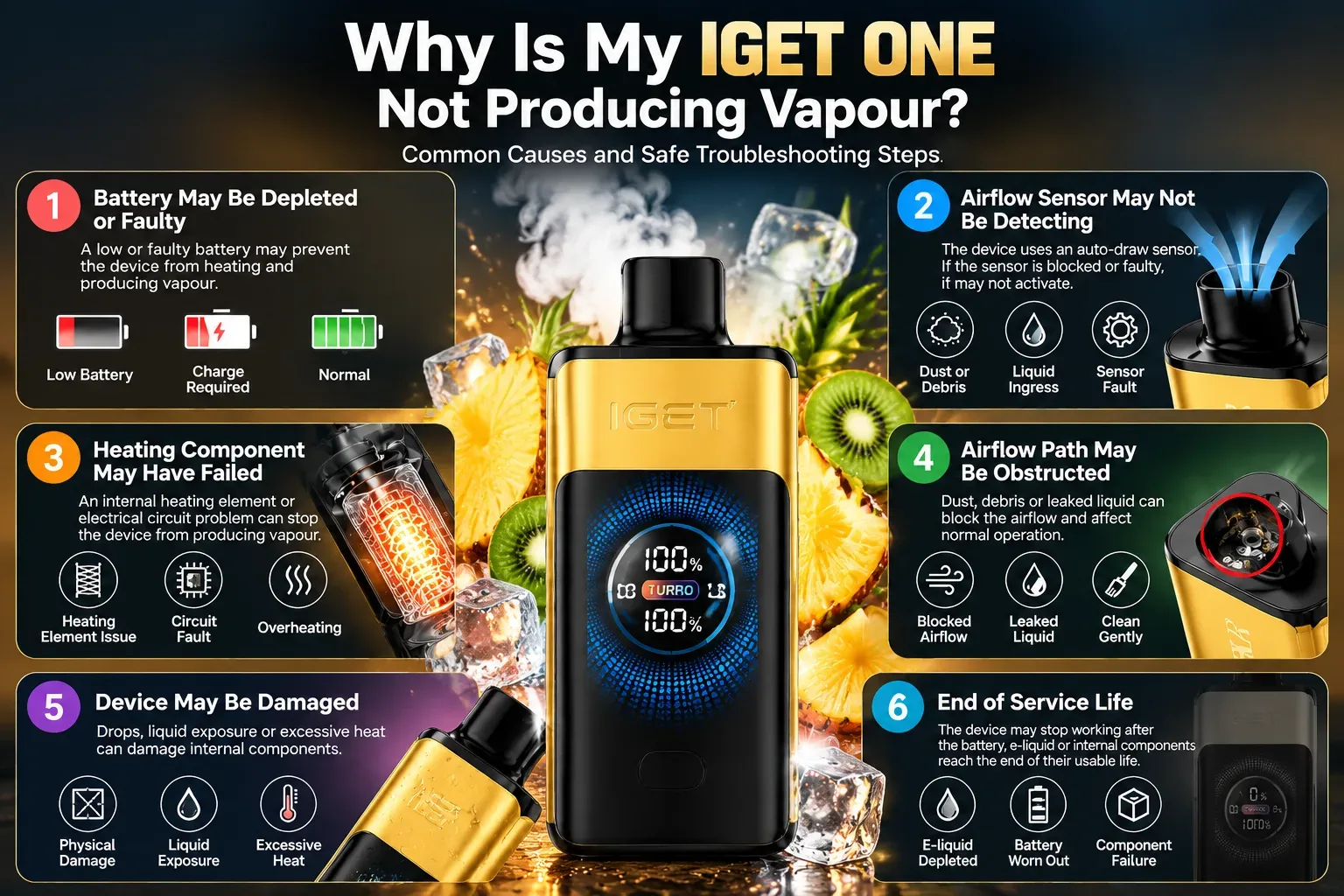
1. How Does an IGET Vape's Auto-Draw Sensor Work?
Many draw-activated vapes do not require a traditional activation button.
Instead, they use an internal airflow or pressure sensor to detect whether the user is inhaling.
The entire process generally involves three steps:
When the user inhales, the airflow or pressure inside the vape changes.
The sensor detects this change and sends a signal to the control circuit to activate the heating element.
When the user stops inhaling, the sensor should return to standby mode, and the heating element should stop working accordingly.
This process is usually completed automatically.
However, if the sensor continues to detect an incorrect airflow signal, or if the control circuit malfunctions, the device may continue operating even after the user has stopped inhaling.
It is important to note that sensor designs and protection systems may vary between different IGET models.
2. Why Does an IGET Vape Keep Auto-Firing? Five Possible Causes
Cause 1: Condensation Builds Up Around the Airflow Sensor
One possible cause is moisture or condensation accumulating inside the device's airflow channel.
During normal operation, warm vapour passes through the internal channel. When this vapour comes into contact with cooler internal surfaces, some of it may condense into liquid.
If condensation comes into contact with sensitive electronic components, it may interfere with airflow detection.
Possible abnormal symptoms include:
The device continues to activate and operate after the user stops inhaling.
Occasional crackling sounds can be heard when the device is not being used.
The indicator light activates inconsistently or flashes irregularly.
However, condensation is only one possible cause, and these symptoms alone cannot confirm that the sensor has been affected.
Cause 2: E-Liquid Enters Internal Electronic Components
Sometimes, the e-liquid inside a vape may leak into areas that are not supposed to come into contact with liquid.
Possible contributing factors include manufacturing defects, damaged seals, or damage caused by external impacts.
When e-liquid comes into contact with the airflow sensor or electronic circuitry, it may interfere with the device's normal activation and shutdown process.
If the device is leaking, it should not be used or charged again until an appropriate safety assessment has been carried out.
Cause 3: The Auto-Draw Sensor Malfunctions
An airflow sensor is essentially an electronic component.
Like other electronic components, it can also malfunction.
If the sensor is damaged, it may incorrectly send an activation signal to the control circuit even when no airflow is passing through.
This may explain the following situations:
The vape suddenly activates when nobody is inhaling.
The device continues making heating sounds after use.
The device's response to inhalation becomes inconsistent.
If the sensor itself is damaged, simply cleaning the outside of the vape will usually not resolve the internal fault.
Cause 4: Internal Damage Caused by Accidentally Dropping the Vape
When an IGET vape is accidentally dropped, the damage may affect more than just its appearance.
The impact may damage internal connections, sensor components, or the battery structure.
Some types of internal damage may not be directly visible on the outside of the device.
If the device begins auto-firing after being dropped, the possibility of physical damage to its internal components should be considered.
Do not open the vape casing yourself to inspect the internal battery or electronic components.
Cause 5: High Temperatures or Electronic Circuit Failure
Higher environmental temperatures may place additional stress on lithium-ion batteries and electronic components.
This is particularly worth paying attention to in Australia.
During hot weather, vapes may be left inside parked cars or exposed to direct sunlight for extended periods.
High temperatures do not necessarily cause a vape to auto-fire directly, but they may increase the risk of battery and electronic component failures, or even spontaneous combustion.
Fire and Rescue NSW recommends not leaving battery-powered devices inside hot cars or in direct sunlight. If a battery shows signs of damage or abnormal heating, use should be discontinued.
3. Is It Normal for an IGET Vape to Keep Producing Vapour After You Stop Inhaling?
A small amount of residual vapour appearing briefly after you stop inhaling does not necessarily mean the device is still powered and operating.
This is because the heating element may retain a small amount of heat after it stops working.
However, there is an important difference between residual vapour and continuous electrical heating.
| What You Observe | Possible Explanation |
|---|---|
| A small amount of vapour appears briefly after inhalation stops | Residual heat remains in the heating element |
| The indicator light stays on abnormally | Possible activation fault |
| The device continues making crackling sounds while idle | Possible continuous heating |
| The device produces vapour on its own without inhalation | Possible auto-firing |
| The vape body becomes abnormally hot | Possible battery or electrical safety hazard |
Continuous automatic activation should not be considered normal.
If you suspect the device is still heating after you stop inhaling, you should stop using it immediately.
4. What Should You Do If Your IGET Vape Starts Firing by Itself?
When this happens, your first priority should be device safety rather than trying to make it work normally again.
Step 1: Stop using it immediately.
Do not repeatedly inhale to test whether the fault has disappeared.
Step 2: If the device is charging and it is safe to do so, disconnect it from the charger.
A vape that has already shown signs of abnormal activation should not continue charging.
Step 3: Keep it away from flammable materials.
If the device is at a normal temperature and can be moved safely, place it on a stable, non-flammable surface away from paper, fabric, and other flammable materials.
Step 4: Watch for abnormal warning signs.
Abnormal heating, swelling, hissing sounds, strong odours, or smoke may all indicate a battery fault.
Do not approach a device that is already showing signs of danger while observing it.
Step 5: Do not disassemble or repair internal components yourself.
Avoid puncturing the device casing, touching the internal battery, adjusting wires, or bypassing electronic protection components.
If the vape is severely overheating, smoking, or catching fire, stay away from the device, evacuate the area if necessary, and call Australia's emergency number, 000.
Fire and Rescue NSW warns that lithium-ion battery failures may release toxic and flammable gases.
5. Can IGET Vape Auto-Firing Cause Overheating?
It is possible.
If the vape continues supplying power to the heating element when it should have stopped operating, the internal temperature of the device may rise.
Possible consequences include:
Damage to the heating element.
Additional stress on the battery.
Reduced performance or damage to other electronic components.
In more serious cases, damaged lithium-ion batteries may pose a fire risk.
It is important to emphasise that not every auto-firing incident will cause a battery fire, but caution is still necessary.
However, whenever a device shows signs of abnormal heating, it should be taken seriously and not ignored, as doing so could lead to danger.
6. Does IGET Vape Auto-Firing Mean You've Bought a Fake?
Not necessarily.
Abnormal activation in a vape may be caused by component defects, liquid contamination, or internal damage resulting from external impacts.
Auto-firing alone cannot determine whether a device is genuine or counterfeit.
Similarly, even if a device's appearance matches the characteristics of a genuine product, it does not guarantee that it is completely free from manufacturing defects.
When determining whether an IGET vape is genuine, consumers should not rely solely on a single visual detail, packaging feature, or QR code.
Product authenticity and operational safety are two different issues.
7. Can You Continue Using an IGET Vape After It Stops Auto-Firing?
It is not recommended.
If a vape has genuinely experienced abnormal automatic activation, it should not be considered safe even if it subsequently returns to normal.
Some intermittent electrical faults are difficult to identify without professional testing equipment.
Continuing to use or charge the device may create additional safety risks.
For disposable or sealed vapes, attempting to disassemble and repair the internal circuitry yourself is particularly dangerous.
8. How Should Australian Users Dispose of a Faulty IGET Vape?
Vapes usually contain lithium-ion batteries and other electronic components, which require appropriate disposal methods.
They should not be thrown directly into ordinary household rubbish bins or kerbside recycling bins.
Fire and Rescue NSW warns that batteries that are not disposed of correctly may cause fires during waste collection and subsequent processing.
For vapes that are damaged, leaking, or overheating, it is recommended to contact your local council or an appropriate hazardous waste disposal organisation to find out the correct disposal method.
Do not place damaged battery-powered devices directly into ordinary battery recycling collection bins.
In addition, Australia has strict restrictions on the supply and public advertising of vaping products. Therapeutic vaping products can only be supplied through pharmacies that comply with the relevant regulations and must meet the applicable requirements.
Frequently Asked Questions (FAQ)
1. Why Does My IGET Vape Still Make Noise After I Stop Inhaling?
A brief sound may be related to residual heat in the heating element.
However, if the device continues making crackling sounds while idle, it may indicate that the heating process has not stopped normally or that the activation system is faulty.
If the sound is clearly abnormal, stop using the device.
2. Can Condensation Cause an IGET Vape to Auto-Fire?
It is possible.
For some vapes that use an auto-draw activation system, condensation coming into contact with the airflow sensor may interfere with the device's normal activation and shutdown.
However, the cause cannot be confirmed as condensation based solely on the symptoms of auto-firing.
3. Why Does My IGET Vape's Indicator Light Stay On After I Finish Inhaling?
Some vape models may have a brief, normal indicator light display sequence.
However, if the indicator light stays on for an abnormally long time, especially when accompanied by heating or continuous vapour production, it may indicate a device fault.
4. Can an IGET Vape Activate by Itself While Sitting on a Table?
It is possible.
If a draw-activated device has a sensor or circuit fault, it may activate unexpectedly even when nobody is inhaling.
Once this happens, stop using the device and treat it as a potential electrical safety issue.
5. Is It Safe to Charge an IGET Vape That Has Experienced Auto-Firing?
It is not recommended.
If the device has experienced abnormal activation, overheating, leakage, or suspected electrical damage, it should not continue charging.
6. Can I Open My IGET Vape and Repair the Airflow Sensor Myself?
It is not recommended.
Opening a sealed vape may expose the internal battery and increase the risk of short circuits, battery punctures, or exposure to chemical substances.
You should not disassemble internal components to carry out repairs yourself.
Conclusion
If your IGET vape continues operating after you stop inhaling, the problem may be related to the auto-draw sensor, internal condensation, e-liquid leakage, or damaged electronic circuitry.
The most important thing is to distinguish between two situations:
One is a small amount of residual vapour appearing briefly after heating has stopped, while the other is the device continuing to receive electrical power and heat even when nobody is inhaling.
If the vape has already shown signs of activating by itself, you should stop using it rather than repeatedly testing it.
Understanding these abnormal symptoms can help Australian consumers identify potential electrical faults and take safer measures.